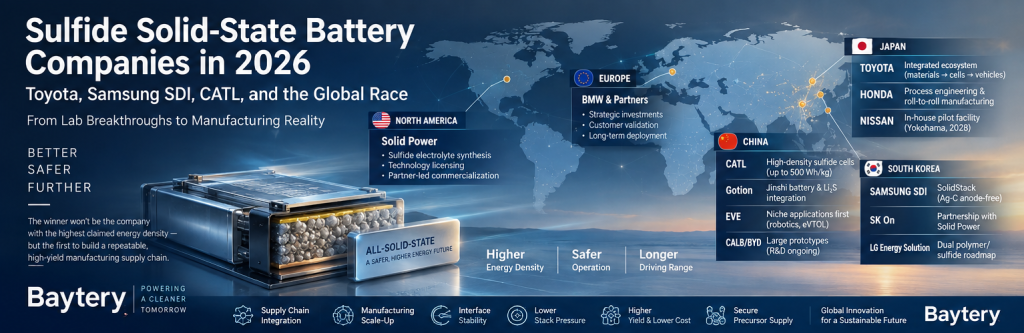
Part 2 of the Battery 2026 Sulfide Solid-State Battery Series
Executive Summary
As sulfide all-solid-state batteries (ASSBs) transition from pilot plants to commercial lines, the solid electrolyte itself has emerged as the ultimate supply-chain bottleneck.
Sulfide electrolytes are uniquely positioned to win the solid-state race: they deliver room-temperature ionic conductivities approaching liquid electrolytes while remaining soft enough to form tight mechanical contacts within dense electrodes. However, the market lacks a mature, standardized supply base. In 2026, nominal capacity means nothing—only qualified capacity matters.
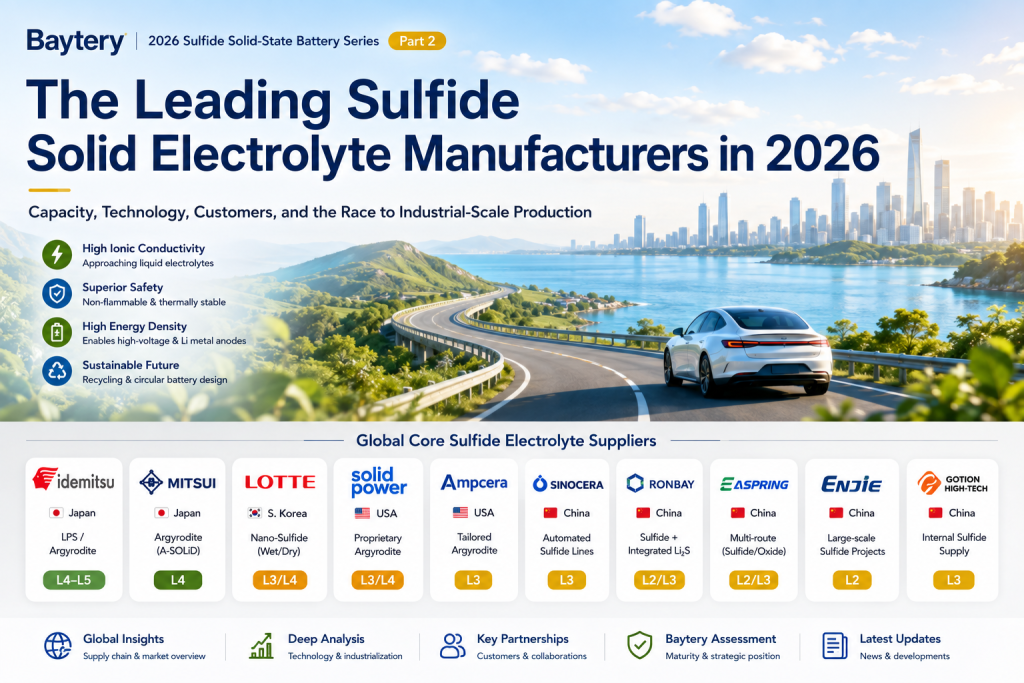
The market is currently anchored by five global pioneers:
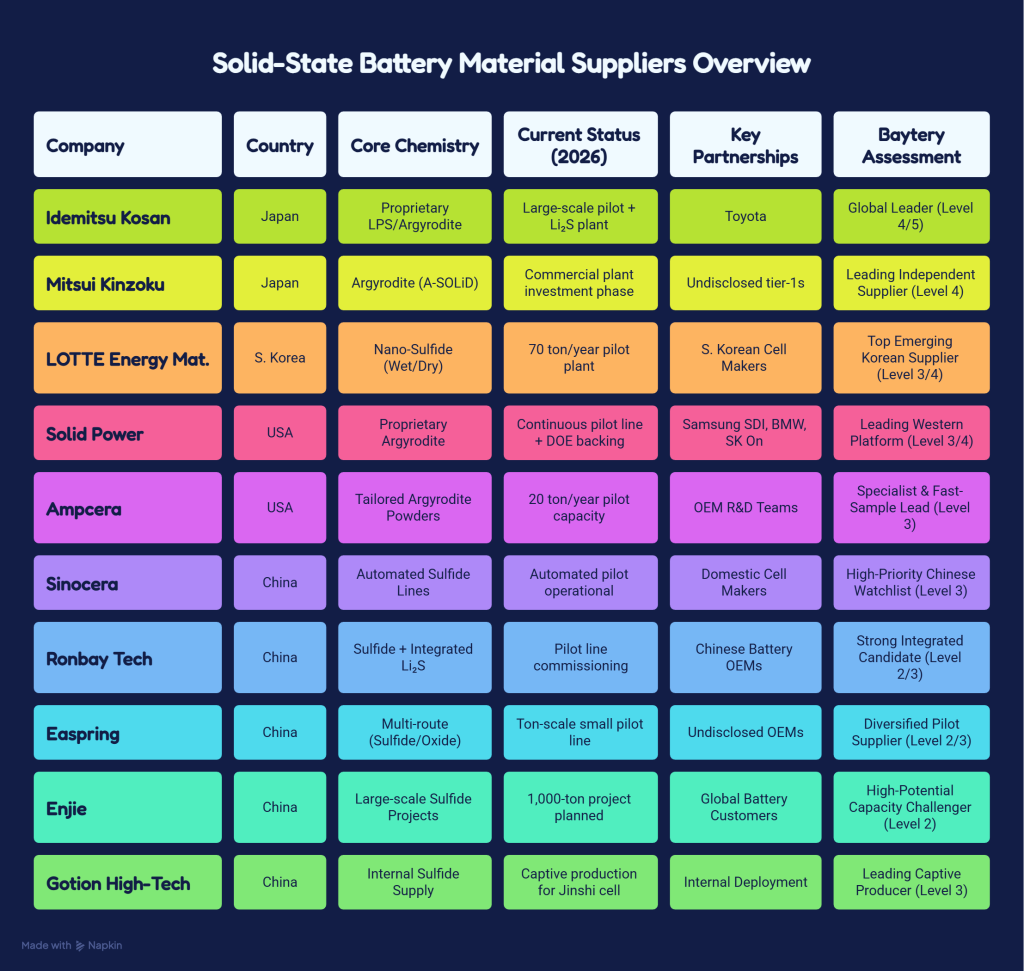
- Idemitsu Kosan (Japan): Building an integrated Li₂S-to-electrolyte ecosystem alongside Toyota.
- Mitsui Kinzoku (Japan): Commercializing its flagship argyrodite material (A-SOLiD) via phased production expansions.
- LOTTE Energy Materials (South Korea): Operating a 70-ton/year pilot facility testing both wet and dry synthesis routes.
- Solid Power (USA): Commissioning continuous production equipment to supply global platforms (Samsung SDI, BMW, SK On).
- Ampcera (USA): Supplying tailorable nano-scale powders via a 20-ton pilot platform.
Concurrently, a wave of Chinese entrants—including Sinocera, Ronbay, Easpring, Enjie, and Gotion High-Tech—are advancing from lab synthesis to automated pilot lines. Winning suppliers won’t simply be those with the highest announced tonnage; they will be the companies that repeatedly deliver strict ionic conductivity, tight particle size distributions, low impurities, and moisture stability at scale.
1. Why the Electrolyte Supply Chain Bottlenecks ASSBs
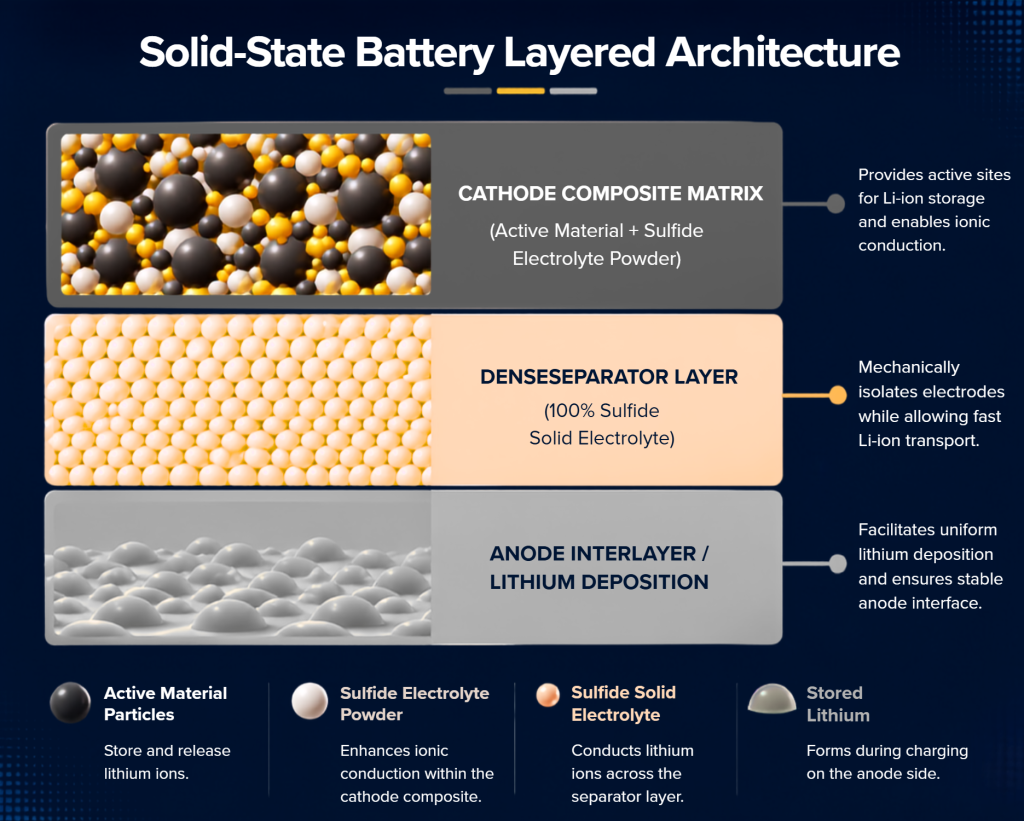
Solid-state architectures require significantly more electrolyte material per cell than conventional liquid lithium-ion batteries. Electrolyte powders are packed directly into four distinct cell layers:
- The primary dense separator layer.
- The cathode composite matrix.
- Anode-side interlayers.
- Specialized protective particle coatings.
Moving from gram-scale synthesis to automotive supply chains requires solving five core engineering bottlenecks:
- Lithium Sulfide (Li₂S) Cost: High-purity precursor costs dominate finished material pricing.
- Moisture Control: Managing H₂S gas generation requires strict dry-room handling (<-50°C dew point).
- Particle Engineering: Fine nano-powders are needed for cathode mixing, while larger, durable grains are required for separator films.
- Batch-to-Batch Consistency: Maintaining identical crystallinity, halide distribution, and ionic conductivity across multi-ton lots.
- Continuous Processing: Moving away from energy-intensive, batch-based mechanochemical ball milling toward scalable continuous synthesis.
2. Major Sulfide Electrolyte Chemistries
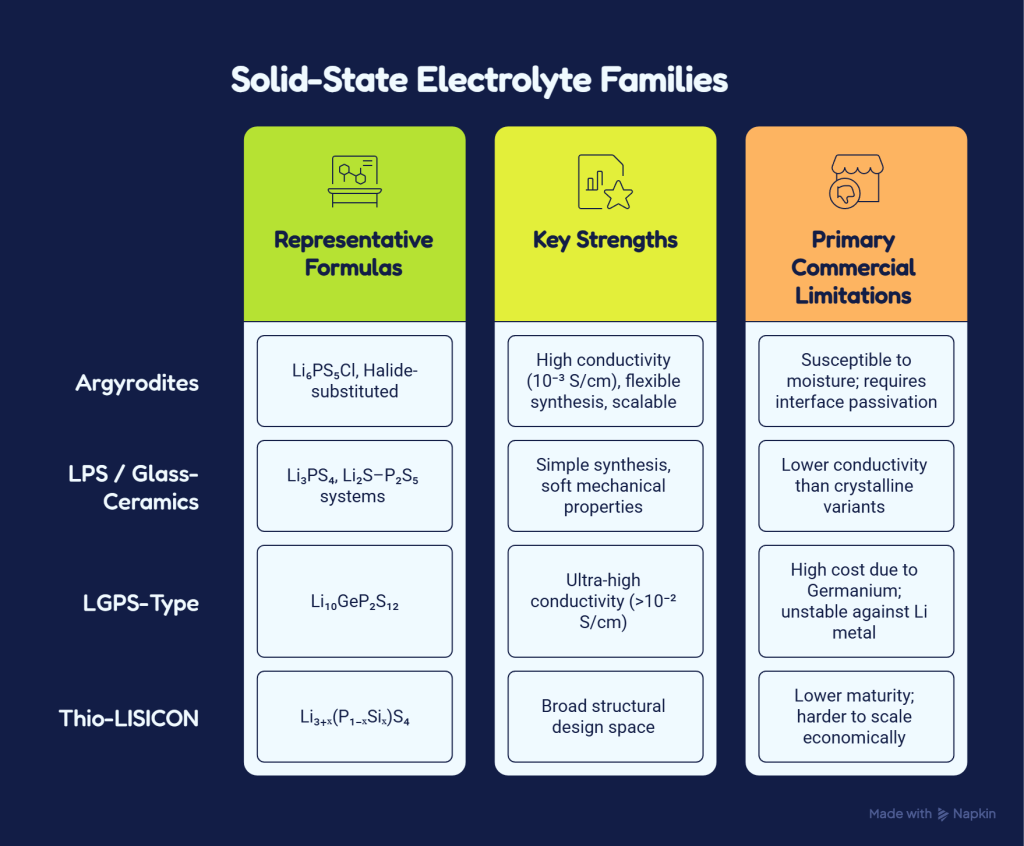
Industry Consensus: Argyrodite and optimized LPS glass-ceramics represent the vast majority of early commercial automotive deployments.
3. Industrial Maturity Scale
To evaluate supplier readiness, Baytery ranks players across five distinct levels:
- Level 1 (Lab Developer): Gram-scale synthesis and basic patent filings.
- Level 2 (Sample Supplier): Kilogram-scale production supplying external academic/R&D teams.
- Level 3 (Pilot Manufacturer): Dedicated equipment producing stable ton-scale batches.
- Level 4 (Customer-Qualified): Material validated in multi-layer automotive customer test lines.
- Level 5 (Mass Production): Commercial plant operating in tandem with a high-volume EV/battery program.
4. Global Supplier Matrix
5. Top Player Deep-Dives
Idemitsu Kosan: The Integrated Heavyweight
- Strategy: Fully integrated supply chain controlling both raw Li₂S precursor production and final electrolyte synthesis.
- Key Alignment: Anchor supplier for Toyota’s commercial ASSB rollout.
- Strengths: Decades of sulfur-refining chemistry experience; direct integration with Toyota’s cell design specs.
- Risks: High ecosystem lock-in—early capacity is almost entirely committed to Toyota.
- Position: Global Front-Runner
Mitsui Kinzoku: The Independent Argyrodite Benchmark
- Strategy: Pure-play material supplier scaling its proprietary A-SOLiD argyrodite electrolyte.
- Key Progress: Executed multi-stage expansions from test units to an initial commercial-scale manufacturing plant.
- Strengths: High ionic conductivity; proven ability to supply independent cell makers outside captive ecosystems.
- Risks: Exact qualified capacity and pricing metrics remain strictly undisclosed.
- Position: Leading Independent Argyrodite Supplier
LOTTE Energy Materials: Korea’s Production Pioneer
- Strategy: Parallel development of both dry (solvent-free) and wet synthesis routes to optimize cost and particle morphologies.
- Key Progress: Operating a 70 ton/year pilot line in South Korea.
- Strengths: R&D into moisture-tolerant formulations operable in standard -35°C to -45°C dry rooms.
- Risks: Requires automotive qualification proof across full GWh-scale lines.
- Position: Strong Industrial Challenger
Solid Power: Continuous Manufacturing Innovator
- Strategy: Transitioning from batch mechanochemical milling to continuous chemical synthesis, backed by a $50M US DOE award.
- Key Progress: Shipped electrolyte lots to Samsung SDI under the BMW joint evaluation initiative in Q1 2026.
- Strengths: Direct feedback loop from internal cell-building operations; strong OEM relationships.
- Risks: Continuous processing equipment must prove long-term runtime reliability and yield.
- Position: Leading Western Platform
China’s Emerging Supply Base
- Sinocera & Ronbay: Leveraging deep backgrounds in ceramic powders and cathode calcination to build automated, low-cost pilot lines.
- Easpring & Enjie: Announcing ambitious thousand-ton projects, though transitioning from separator films or oxides to reactive sulfides requires unproven process overhauls.
- Gotion High-Tech: Building fully captive Li₂S and electrolyte synthesis to supply its internal Jinshi cell line directly.
6. Strategic Takeaway
The market for sulfide solid electrolytes is moving rapidly from R&D sampling to industrial qualification.
While Japanese suppliers (Idemitsu, Mitsui Kinzoku) hold early leads in captive integration and product maturity, Western platform developers (Solid Power) and aggressive Chinese material vendors (Sinocera, Ronbay) are closing the gap. The long-term winners will be suppliers capable of lowering raw Li₂S input costs while guaranteeing strict batch-to-batch uniformity under industrial dry-room conditions.