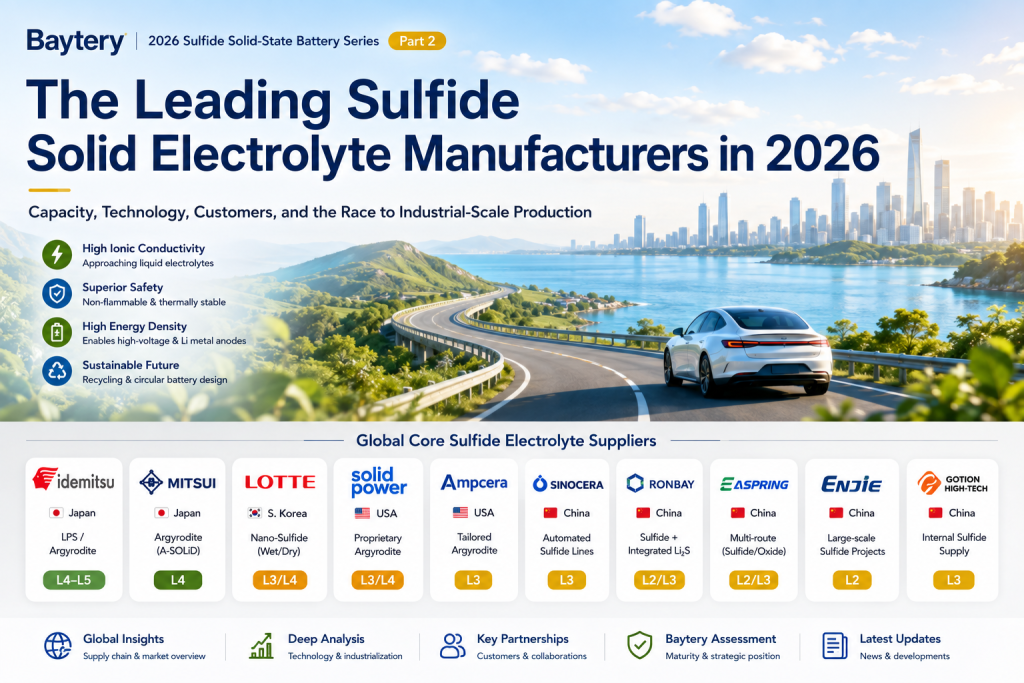
Part 1 of the Baytery 2026 Sulfide Solid-State Battery Series
Executive Summary
In 2026, the global race to commercialize sulfide-based all-solid-state batteries (ASSBs) has shifted from laboratory benchmarks to harsh manufacturing realities.
While sulfide electrolytes remain the most promising candidate—offering high room-temperature ionic conductivity and mechanical softness for intimate solid–solid contact—high conductivity alone will not deliver a commercial product. The winners will be determined by six practical engineering metrics:
- Multilayer Cell Scaling: Manufacturing automotive-grade, multi-layer pouch/prismatic cells.
- Interface Stability: Controlling degradation and void formation over 1,000+ cycles.
- Stack Pressure: Reducing operating pressure requirements to auto-industry thresholds.
- Safety & Processing: Handling moisture-sensitive materials and preventing H₂S gas release.
- Yield & Economics: Achieving production yields and costs competitive with conventional Li-ion.
- Precursor Supply: Securing scaled, battery-grade Li₂S and solid electrolyte feedstocks.
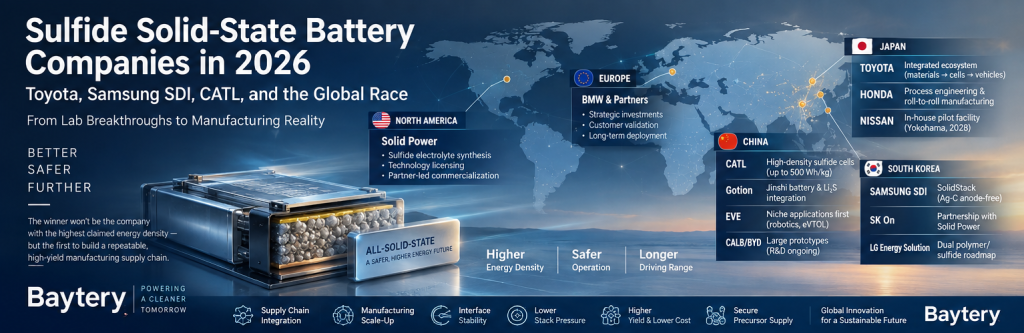
Based on technical progress through August 2026, Toyota, Samsung SDI, Honda, Nissan, Solid Power, and leading Chinese cell makers represent the core global programs. The winner won’t simply be the company with the highest claimed energy density—it will be the first to build a repeatable, high-yield manufacturing supply chain.
1. Why Sulfides Drive Next-Gen Batteries
All-solid-state batteries replace flammable liquid electrolytes and polymer separators with solid ion-conducting layers, enabling higher energy densities, thinner packs, and enhanced thermal stability.
Sulfide solid electrolytes (including LPS, LGPS, and argyrodites like Li₆PS₅Cl) dominate industrial roadmaps because:
- High Conductivity: Compositions like LGPS reach ionic conductivities exceeding 10⁻² S/cm at room temperature, rivaling liquid electrolytes.
- Mechanical Softness: Unlike rigid, brittle oxides, sulfides deform under moderate pressure to maintain interfacial contact with active electrode materials.
Despite these advantages, sulfides remain sensitive to moisture, prone to dendrite growth, and expensive to synthesize at scale.
2. Evaluation Framework
To evaluate commercial readiness, Baytery ranks players across four concrete criteria:
- Sulfide Route Evidence: Publicly verified sulfide electrolyte programs, patents, or pilot infrastructure.
- Cell Maturity: Progress from coin cells to automotive-format, multi-layer prototypes and customer samples.
- Manufacturing Readiness: Dry-electrode processing, roll pressing, continuous coating, yield, and precursor sourcing.
- Commercialization Credibility: Priority given to operating pilot lines and firm supply agreements over hypothetical roadmap dates.
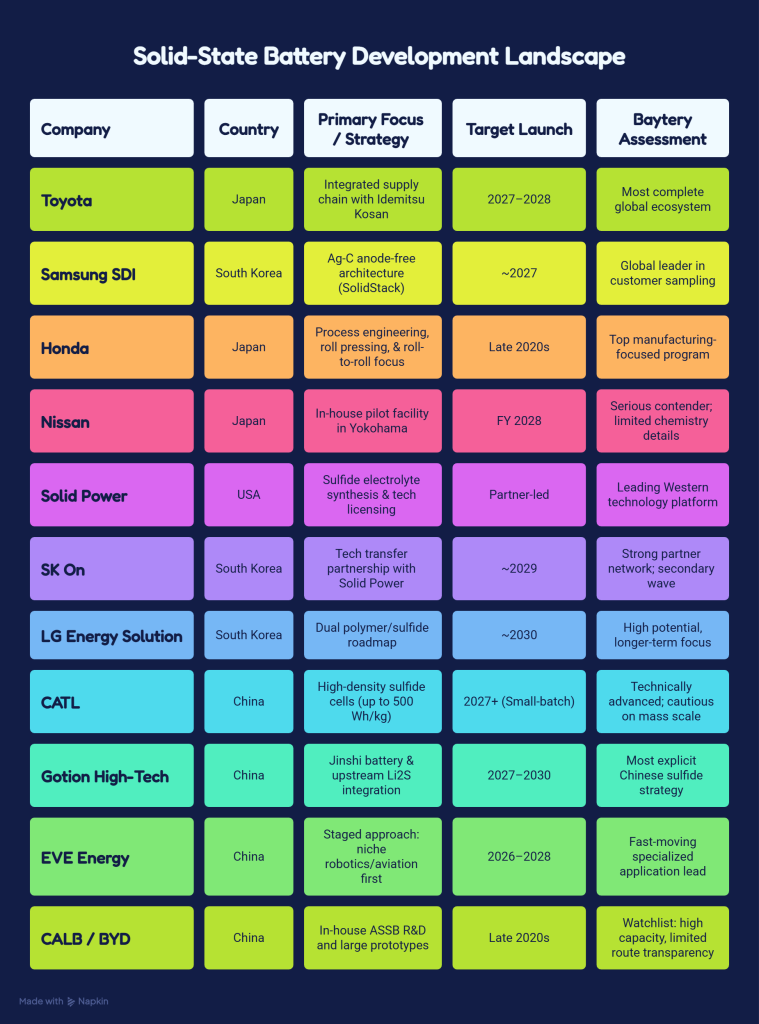
3. Global Players at a Glance
4. Key Player Deep-Dives
Toyota: Integrated Ecosystem Leader
- Strategy: Vertical integration linking material synthesis, cell design, and automotive platform engineering.
- Key Alliance: Joint industrialization partnership with Idemitsu Kosan for sulfide electrolyte production, backed by Idemitsu’s large Li₂S facility in Chiba (targeting completion in mid-2027).
- Key Strengths: Massive patent portfolio, deep internal EV integration, and secured precursor supply.
- Main Risks: Historical timeline shifts; scaling high-yield multi-layer cells remains unproven at gigawatt-hour scale.
- Position: Global Front-Runner
Samsung SDI: Sampling & Platform Lead
- Strategy: Proprietary SolidStack platform using a silver–carbon (Ag-C) composite anode layer to enable uniform, dendrite-free lithium plating.
- Key Progress: Operating dedicated S-Line pilot facility in Suwon since 2022; actively shipping automotive-format evaluation samples to OEMs (including BMW).
- Key Strengths: Advanced customer validation phase; strong South Korean materials ecosystem.
- Main Risks: High material costs (silver) and strict operating pressure constraints.
- Position: Global Front-Runner
Honda: Manufacturing Process Specialist
- Strategy: Solving industrial scale-up barriers via continuous roll-pressing techniques to achieve dense, defect-free solid electrolyte layers.
- Key Progress: Operating a 27,400 m² demonstration facility in Tochigi.
- Key Strengths: Focuses directly on high-speed process engineering and cost reduction (targeting a 50% pack size reduction).
- Main Risks: Discloses less internal cell-chemistry data than competitors.
- Position: Leading Scale-up Developer
Nissan: In-House Auto Integration
- Strategy: Fully internal pilot line integration targeting passenger EVs and light-duty pickup trucks.
- Key Progress: Establishing a ~100 MWh pilot facility at its Yokohama plant for launch in fiscal year 2028.
- Key Strengths: Direct alignment between cell packaging and vehicle platforms; dry-electrode R&D.
- Main Risks: Limited public disclosure on exact electrolyte formulations and cycle life.
- Position: Serious Late-2020s Contender
Solid Power: The Western Platform Model
- Strategy: Pure-play electrolyte supplier and technology licensing platform rather than high-volume cell manufacturer.
- Key Progress: Tech-transfer agreements with SK On and BMW; commissioning continuous sulfide electrolyte synthesis lines.
- Key Strengths: Flexible commercial model; strong OEM backup.
- Main Risks: Entirely dependent on manufacturing partners to commercialize finished cells.
- Position: Leading Western Platform
CATL & Chinese Contenders: Scale vs. Public Transparency
- CATL: Holds extensive sulfide patents and high energy density targets (~500 Wh/kg), but leadership remains public-facingly cautious, classifying current ASSBs at level 4 on a 9-level readiness scale. Focuses on small-batch pilot validation before committing gigawatt-hour capacity.
- Gotion High-Tech: Unveiled its Jinshi sulfide battery (~350 Wh/kg) alongside explicit plans to build internal Li₂S precursor capacity.
- EVE Energy: Commercializing sulfide/halide composite cells first in high-margin, low-volume sectors (humanoid robotics, low-altitude aviation/eVTOL) before entering automotive markets.
5. Strategic Takeaway
The global sulfide solid-state battery race has matured beyond lab claims.
While Toyota and Samsung SDI maintain the clearest overall leads in supply-chain integration and customer sampling, manufacturing-centric programs from Honda and targeted deployments by EVE Energy demonstrate that commercialization will occur in waves. Early revenue will likely be captured in specialized high-margin applications, followed by premium automotive rollouts between 2027 and 2030.